

Restaurants Are Sabotaging Themselves — Here’s How
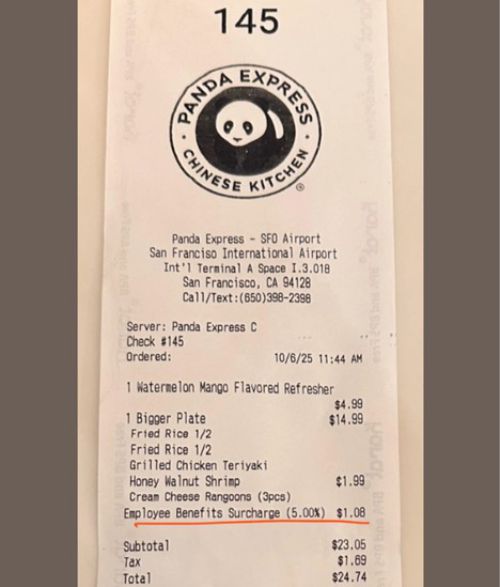
An outraged customer recently shared a receipt from a Panda Express restaurant showing a new fee: a 5% “Employee Benefits Surcharge.” It didn’t take long for it to go viral.
Panda isn’t alone. Surcharges and surprise fees are appearing on restaurant bills with increasing frequency — often leaving diners annoyed, confused, or feeling deceived. With restaurant loyalty being largely dependent on customer experience, undermining their trust not a great strategy.
The Restaurant Business Is in a Tough Spot
Restaurants have been fighting uphill since the pandemic. Owners are dealing with rising food and wage costs, labour shortages, and thinning margins. Making matters worse is a customer base that is financially stressed and increasingly opting against dining out.
The options for a restaurant to survive in this environment are limited. They can raise menu prices, reduce staffing, buy cheaper ingredients or shrink portions. These are, of course, all risky actions. Sadly, there now seems to be a trend toward a fourth option – one with even worse long-term consequences.
The Rise of Phantom Charges
Many restaurants are now focused on increasing their revenue through phantom charges—non-value-add charges on customers. Surcharges, unexpected fees and mandatory tips are popping up everywhere.
Customers have reported benefit-related surcharges at Jersey Mike’s, “no-ice” charges at Dunkin’ Donuts, and “employee benefit and retention fees” tacked onto self-checkout transactions at Newark Airport. One Washington, DC restaurant even added a 20% service fee to be “distributed to the front of the house non-management employees in the form of wages and benefits.”
“Mandatory gratuities” have been around for decades when there are large groups — with restaurants ignoring the oxymoron that “gratuity” comes from the Latin term: “given freely, without obligation.” They are now being applied for all customers in some restaurants.

Why All These Phantom Charges Are Horrible Ideas
The root of loyalty is trust. Trust, and its pillars of Caring, Competency and Integrity, is created by customer experiences. Here is how these phantom charges impact trust:
Hidden fees
Hidden fees instantly compromise integrity. This is particularly true when customers don’t learn about them until the bill arrives. It feels sneaky, and signals that a restaurant isn’t transparent about its pricing.
Operational fees
Operational fees, such as ‘Employee benefit surcharges’ send messages to customers that “We don’t pay our people adequately, so we’re passing it to you.” That strategy doesn’t build restaurant loyalty. It builds resentment.
Mandatory tips
A mandatory “tip” is not a tip, and customers know it. The intent of gratuities is for customers to express their appreciation of the experience they’ve received. They are a way, for those who can afford it, to reward employees for a job well done. When it’s made mandatory, it becomes a fee – and the results are predictable. Customers stop trusting you, they stop returning, and they tell other people.
A Better Option
There’s a better option. It’s not an easy one, but I’ve heard it voiced from countless individuals who are annoyed with the phantom charges, and it is one that doesn’t compromise the trust of customers:
Raise your prices. Raise them enough so you can pay employees appropriately, and so that customers don’t have any unpleasant surprises. I know that this sounds simplistic, and risky in a highly competitive environment — but as long as your overall customer experience is consistently excellent, any negative impact will be minimal.
Restaurant loyalty isn’t built on price; it’s built on trust
Yes, a few customers balk at the higher prices. But what they won’t do is lose trust in you — and those who are loyal to you will never have a reason to defect. Here is one restaurant that made it work.