

Guide Your Customer Service Training Initiatives With These Six Pillars of Customer Service
When you are looking to improve the customer service in your organization, one of the first things you need to do is identify is the specific behaviours that need to be targeted. What are the performance gaps that need to be closed?
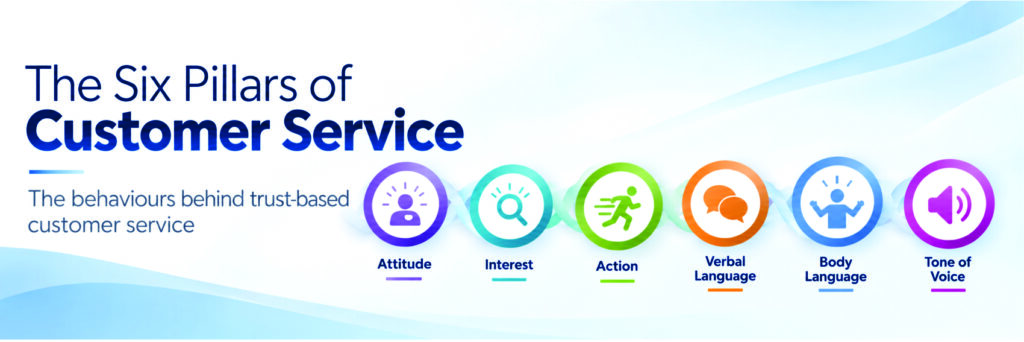
Customer service behaviours fall into six fundamental categories, which we refer to as the Six Pillars of Customer Service. They provide a good starting point for the development of trust-based customer service training programs, coaching plans or incentive strategies:
The Six Pillars Of Customer Service
Attitude
Attitude includes caring. Being solution driven. Having empathy. Being positive. Being friendly and cheerful. Having energy. Being on-stage. Attitude is the cornerstone of trust-based customer service, and contrary to popular belief, a great training program can influence it.
Interest
Interest is being 100% Customer-focused. Asking questions. Listening. Personalizing the relationship. All of our actions need to convey to a customer that they are important to us. The research tells us that over 80% of service failures come from the perception that you just don’t care.
Action
Taking ownership. Solving problems. Being creative. Following through. Following up. When customers see you being proactive, or taking immediate action to ensure their satisfaction, they consider this a positive experience. Over 90% of customers consider “taking ownership” as the primary factor in WOW customer experience.
Verbal Language
Using positive words & phrases. Avoiding negative language. Communicating accurately. Communicating appropriately. Managing expectations. Our language skills play a key role in creating outstanding experiences and building trust.
Body Language
Face. Smile. Eyes. Posture. Movement. Attire. Even when our mouths aren’t speaking, our body is. Poor body language can often undermine otherwise positive messages.
Tone of Voice
Persuasion. Influence. Empathy. Energy. These are conveyed through the five controllable attributes of voice: Speed, Pitch, Loudness, Intonation and Timbre. It’s not what you say, but how you say it, and voice training can have a big impact. This is the single most neglected, yet one of the most powerful skill sets.
Use these pillars of customer service to guide your training
Each of these pillars involve very specific skill sets that you can target, and, of course, not all of the pillars apply equally, or in every work environment. Take the time to examine what you would like to accomplish, then use the six pillars of customer service to guide your training or coaching initiatives.
When building your training, check out the 11 rules for successful training, and the Trust-Based Framework for Customer Experience.
Good luck!
“Don’t be fooled into thinking that customer service is simply common sense. There are a great many skills involved that are difficult to master”